March 2026 development update
In this blog post, I want to share a short update on recent Nirvati development and what's next.
For those new to Nirvati: Nirvati is a FOSS server management software that tries to go beyond other similar project's capabilities in security and other features. You can use it for private messaging, personal data storage, a personal Bitcoin and Lightning Node and many other things.
It tries to be a secure and modern alternative to projects like CasaOS, startOS, or umbrelOS with unique features such as a strict permission system, integrated HTTPS, VPN for remote access, or multi-user support (beta).
Highlights:
- Nirvati 0.9.0 with a new server overview and an emergency repair feature
- Improved Lightning Wallet Connection experience with revokable mobile wallet connections
- Plans for the future including multi-disk support, disk encryption, and a new app store protocol
Nirvati 0.9.0
Recently, Nirvati.0.9.0 was released.
While I did not manage to release everything I wanted as part of this release, there are still a few interesting things:
A new server overview
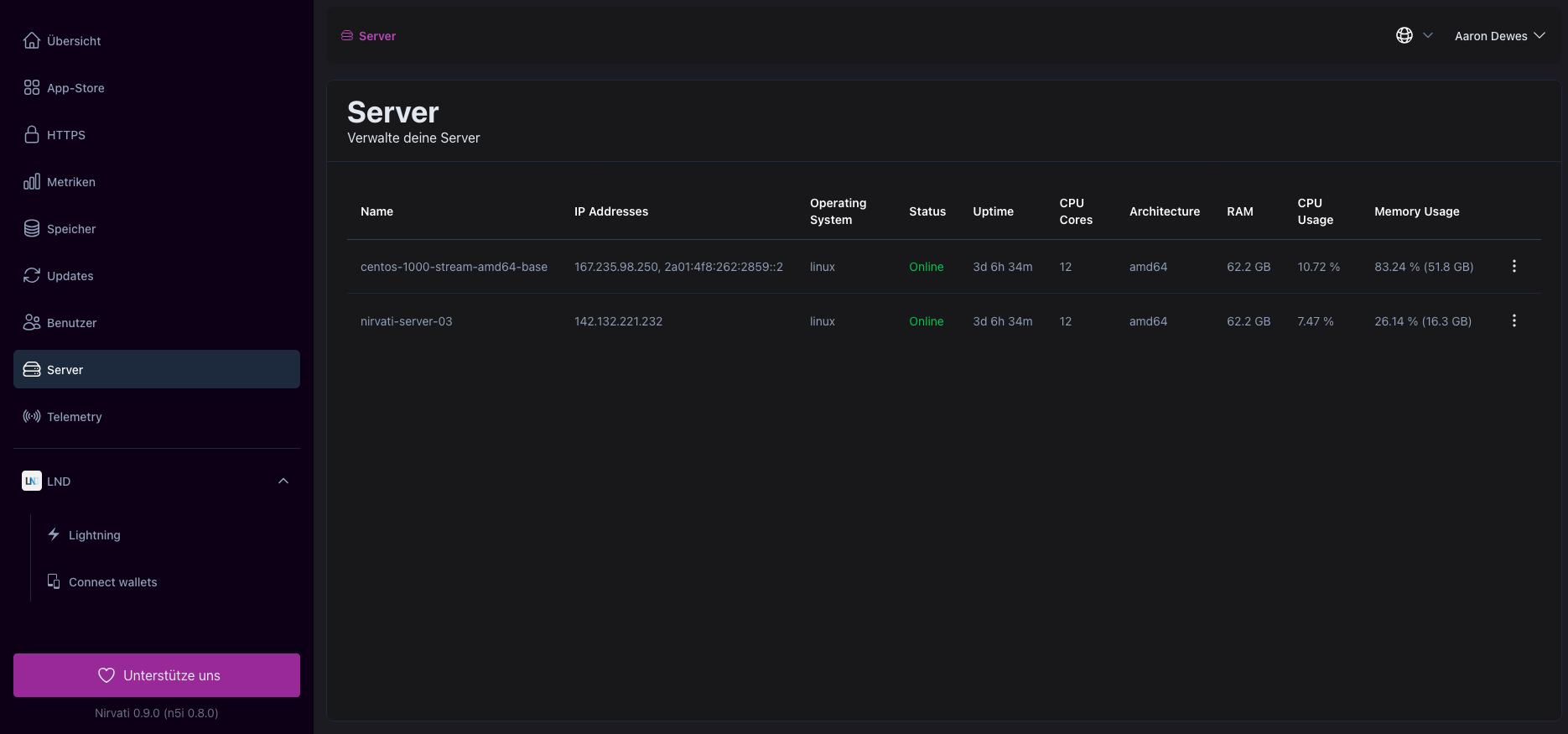
This shows all servers that are part of your Nirvati system. While most users have a single-server system, Nirvati plans to offer easier multi-server setups in a future version. It is already possible, there just isn't a nice UI for adding new servers yet.
This update adds an overview where you can see all servers you have in Nirvati, as well as their resource usage and IP addresses and shut them down if you want to.
Emergency repair
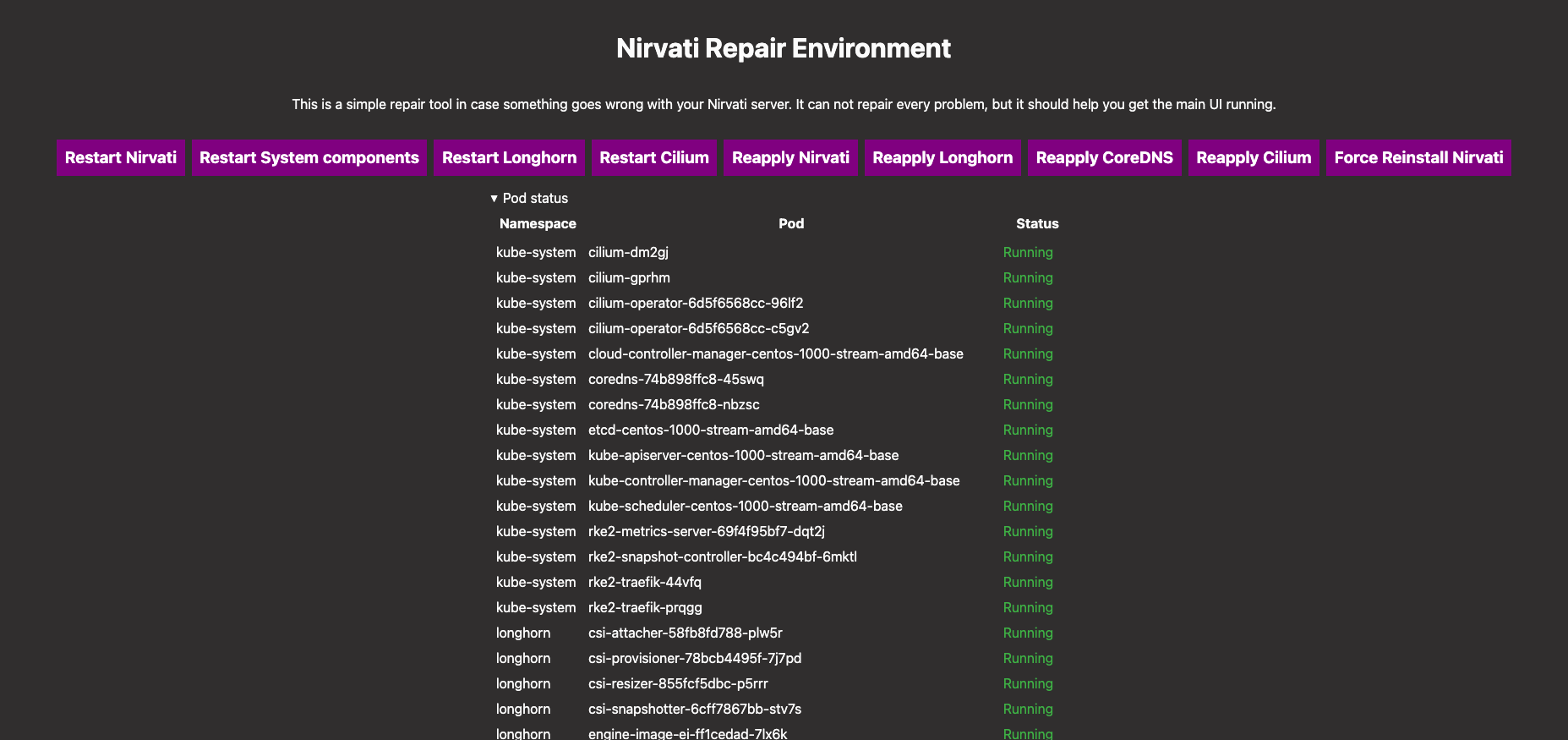
The new emergency repair feature that allows you to repair Nirvati if something goes wrong with the installation or an update. It is accessible on port 9080 and helps fix common problems that prevent Nirvati from starting.
Other changes
Apart from that, a few minor changes have been made:
- Redesign the Contribute page to allow you to make financial contributions to Nirvati from the dashboard
- Allow configuring Tailscale settings
- Prevent installing conflicting apps (e.g. Bitcoin Core and Bitcoin Knots) at the same time
- Various other bug fixes and improvements
Nirvati 0.9.1
Today, I've also released Nirvati 0.9.1. This minor update mostly includes improvements for new installations. It also includes the backend components to support a new app store format that will improve the app store's capabilities in the future.
Improved Lightning Wallet Connection experience
The LND app on Nirvati recently received an update that adds a new security feature that as far as I know, is not available on any other managed node software for LNDConnect (It is possible through Alby Hub with Nostr Wallet Connect): Revokable mobile wallet connections.
You can now connect mobile wallets to your Lightning node, and completely revoke their access afterwards.
This helps keep your node secure if you ever lose your phone.
Other similar projects often give you an irrevokable connection, which means that if you lose your phone, you also lose access to your Lightning node, which can be a big problem if you have a lot of funds in your node.
Plans for the future
This is what I'm working on currently.
As a full time Cybersecurity student at the moment, I can not work full time on Nirvati as well, so I hope you understand that it takes longer for me to release features than it may take for bigger projects, but I think Nirvati is doing quite well considering its size.
Bitcoin payments
One-time payment ("conventional" methods)
Recurring payments (Bitcoin currently not supported)
Nirvati Connect
Our VPN service sadly requires some more work to make it work as good as planned with Nirvati - but there'll be an update.
Multi-disk support
We're also currently in progress of testing multi disk support and plan to provide an early testing experience in version 0.10.0 or 0.11.0.
The initial preview will have a major limitation, but we are working on removing that in a future update: Apps can not span across multiple disks (No RAID-0). The initial beta will only support for each app's data to be on one disk, with the other disk being able to act as a mirror if you want.
Disk encryption
Another feature we're currently working on is partial disk encryption. This will allow you to encrypt the following data:
- TLS certificates
- Data inside apps
- Sensitive environment variables for app containers (in compatible apps)
While the following information is still unencrypted at the moment:
- Usernames on the system
- List of installed apps
- List of connected domains
While this does not provide 100% security, it provides a reasonable level of security for Nirvati servers while still allowing a good user experience.
New app store
I'm also working on a new app store protocol, with the goal of eventually adding these features:
- Make it more transparent who packaged the app for Nirvati (if not the original developer)
- Allow installing beta versions or older versions of apps
- Allow upgrades to intermediate versions (for example, if you're on version 1 of an app, you may first need to update to version 2 to install version 3)
I can not share a timeline for these new features, but I will share updates as soon as I have them.